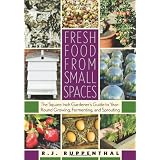
Average Reviews:

(More customer reviews)[Update: I read the book again; and I wish I had given it five stars rather than four. I cannot seem to edit the number of stars. But just pretend that I gave it five stars, OK? Thanks!]
'Fresh Food from Small Spaces' is an exciting book, an inspirational and informative book. Ruppenthal's main topics are container gardening, sprouting, fermenting, growing mushrooms, and small livestock (chickens and bees only), making compost and worm boxes. He lists and describes steps that anyone can take towards helping to build a more sustainable planet and living more lightly on the earth, as well as being more self-reliant.
I was very glad to see a short chapter on 'Survival During Resource Shortages' and one on 'Helping to Build a Sustainable Future'. The 'Introduction' also touches on these topics.
I was also glad to see that Ruppenthal recommends the use of Self-Watering Containers. I know from personal experience (and from being the listowner for a list devoted to Edible Container Gardening) that this is a very, very superior way to grow vegetables in containers.
What the book is *not*: it is definitely not a how-to book. It is *not* the only book you'll ever need about *any* of the topics that it covers. If you buy the book thinking that it is, you'll probably be disappointed. Instead, it gives an excellent general overview and introduction to some very disparate topics. It gives you ideas for things *you can actually do*. The author also points you towards more detailed sources of information on each topic. I doubt if anyone could have written a detailed instructional guide on all of these very different topics.
Major disappointment: the only illustrations are black-and-white stock photos. Some color photos - and more personal photos - would have been a great addition. This is really a very glaring lack. (Shame on you, Chelsea Green Publishers!)
Second major disappointment: no index. I would have expected an index in anything published by Chelsea Green, a quality publisher.
Major plus: The book is referenced, with endnotes. There is a list of resources as well.
I would definitely have given this book my unalloyed praise if it only had better photos and an index. I have no other criticisms. Ruppenthal writes well, too, by the way.
[...]
Click Here to see more reviews about: Fresh Food from Small Spaces: The Square-Inch Gardener's Guide to Year-Round Growing, Fermenting, and Sprouting
Books on container gardening have been wildly popular with urban and suburban readers, but until now, there has been no comprehensive "how-to" guide for growing fresh food in the absence of open land. Fresh Food from Small Spaces fills the gap as a practical, comprehensive, and downright fun guide to growing food in small spaces. It provides readers with the knowledge and skills necessary to produce their own fresh vegetables, mushrooms, sprouts, and fermented foods as well as to raise bees and chickens--all without reliance on energy-intensive systems like indoor lighting and hydroponics.
Readers will learn how to transform their balconies and windowsills into productive vegetable gardens, their countertops and storage lockers into commercial-quality sprout and mushroom farms, and their outside nooks and crannies into whatever they can imagine, including sustainable nurseries for honeybees and chickens. Free space for the city gardener might be no more than a cramped patio, balcony, rooftop, windowsill, hanging rafter, dark cabinet, garage, or storage area, but no space is too small or too dark to raise food.
With this book as a guide, people living in apartments, condominiums, townhouses, and single-family homes will be able to grow up to 20 percent of their own fresh food using a combination of traditional gardening methods and space-saving techniques such as reflected lighting and container "terracing." Those with access to yards can produce even more.
Author R. J. Ruppenthal worked on an organic vegetable farm in his youth, but his expertise in urban and indoor gardening has been hard-won through years of trial-and-error experience. In the small city homes where he has lived, often with no more than a balcony, windowsill, and countertop for gardening, Ruppenthal and his family have been able to eat at least some homegrown food 365 days per year. In an era of declining resources and environmental disruption, Ruppenthal shows that even urban dwellers can contribute to a rebirth of local, fresh foods.
 Get 34% OFF

0 comments:
Post a Comment