Average Reviews:

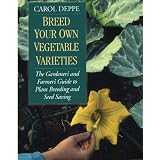
(More customer reviews)I fell in love with the first edition of Breed Your Own Vegetable Varieties, and I am even more delighted with this second edition (published in December, 2000). It is rare to find an author with Carol Deppe's depth of scientific knowledge who is able to distill what is most useful from that knowledge and combine it with a large dose of practical experience. Add to this the fact that Deppe is a captivating storyteller, and you have an informative book that is truly a delight to read.
While Deppe clearly has one foot in the world of genetics and the science of plant breeding, the other she has firmly planted among the peas and squash in her own garden. She relates tales of her garden ventures and introduces you to other adventuresome plant breeders. As you read on, you will find yourself daydreaming about a new variety, perhaps a tomato that would have "real" tomato flavor, be extra nutritious, grow happily in one of your homemade tomato cages, and thrive in your garden. But, as Deppe explains, the only way to get that variety is to breed it yourself. The professional plant breeders won't do it for you. Their attention is focused on a few commercially important food crops, their goal the development of those traits that are of benefit to commercial growers, such as suitability for mechanical harvesting and long distance transport. Deppe's focus is on breeding varieties that, among other things, thrive under organic and/or sustainable growing conditions.
Gardeners and small scale farmers can, and do, breed the varieties they want. Although successful plant breeding doesn't necessarily require a lot of time or garden space, it does require some knowledge---thus, the primary need for this book. The technical chapters are well-crafted guides to the principles of genetics combined with practical and workable strategies for applying those principles. Especially useful are the sections on designing garden trials and on how to be certain you are indeed selecting for the traits you want. There are also detailed illustrated instructions showing how to breed eight popular vegetables: tomato, lettuce, pea, bean, corn, onions and relatives, cabbages and relatives, and squash/pumpkins. An appendix contains essential data for breeding 801 cultivated vegetables and their wild relatives, useful information for all plant breeders.
Deppe also shares many practical techniques, methods, and strategies, gleaned from years in the garden. These tips are invaluable. They get you thinking about ways that you could experiment and explore more with the garden resources you have. And when things don't go quite as hoped, she reminds you that you can eat your mistakes.
At the heart of any plant breeding venture is good seed saving practice. Even gardeners who do not consider themselves to be plant breeders, when faced with the disappearance of their old favorites from the seed catalogs suddenly want to save their own seed. There are a number of factors you must handle properly if you are going to save your own seed and maintain vigorous, pure strains. The six new chapters added to this edition to cover this area take seed saving much farther than has been done elsewhere. There is a whole chapter devoted to selecting the individual plants from which you will want to save seed, while other chapters discuss isolation practices, the number of plants required, and other factors.
Even if all the vegetables on your table come from the grocery store, you might want this book for the new chapter that compares the advantages and limitations of classical plant breeding techniques with those of genetic engineering. Deppe provides a perceptive discussion of the results, both intended and unanticipated, of applying genetic engineering to the development of food crops. She also explains why classical plant breeding methods remain an important, and in many instances preferable, tool for enhancing our food supply.
All in all, an informative, insightful, and most enjoyable book that is an essential guide for gardeners and small scale farmers alike.
Click Here to see more reviews about: Breed Your Own Vegetable Varieties: The Gardener's & Farmer's Guide to Plant Breeding & Seed Saving
 Get 34% OFF

0 comments:
Post a Comment